
Why our raw dog food is labelled complementary – and why we don’t follow FEDIAF guidelines
If you feed raw, you may have noticed that many raw dog foods — including ours — are labelled “complementary” rather than “complete”. This often leads to confusion, and sometimes concern.
In this article, we explain what complementary raw dog food really means, what FEDIAF guidelines are, and why we choose not to formulate our raw food to meet FEDIAF “complete” standards.
What does “complementary raw dog food” mean?
Under UK and EU animal feed legislation, pet food must be labelled either complete or complementary depending on the nutritional claim being made.
-
Complete dog food is claimed to provide all nutrients required when fed alone as the daily ration.
-
Complementary dog food is not claimed to meet all nutritional requirements on its own and is intended to be fed as part of a broader diet.
This is a legal definition, not a measure of ingredient quality or how “good” the food is.
Labelling our food as complementary is about honest, compliant labelling — not about cutting corners.
What are FEDIAF guidelines? (Explained simply)
FEDIAF (the European Pet Food Industry Federation) publishes nutritional guidelines used by manufacturers to formulate “complete” pet foods.
These guidelines specify minimum and maximum levels for a wide range of nutrients, across different life stages. They are widely adopted across the commercial pet food industry.
FEDIAF member companies include large multinational pet food manufacturers such as:
-
Mars PetCare
-
Nestlé Purina PetCare
-
Hill’s Pet Nutrition
-
Affinity Petcare
-
WellPet
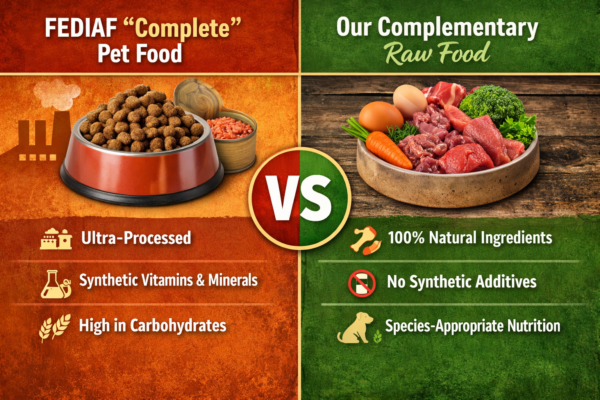
These companies predominantly produce ultra-processed, extruded or canned diets, not raw food.
Why we do not formulate our raw food to FEDIAF guidelines
1. FEDIAF guidelines are designed for manufactured diets
FEDIAF nutritional targets are most easily achieved using synthetic vitamin and mineral premixes. This is standard practice in extruded kibble and canned foods, where nutrients lost during processing must be added back in artificially.
Achieving exact FEDIAF targets using only whole, natural raw ingredients is extremely difficult, and in some cases impossible, without synthetic supplementation.
👉 We do not want to build our recipes around synthetic nutrients.
2. We reject a “kibble-style” formulation mindset
Most FEDIAF-compliant diets are:
-
Highly processed
-
Carbohydrate-heavy
-
Designed for long shelf life and manufacturing efficiency
Raw feeding works on a completely different principle — using:
-
Whole animal ingredients
-
Minimal processing
-
Natural nutrient availability
-
Balance achieved over time, not in a single formula
Trying to force raw food into a framework designed for ultra-processed diets does not make nutritional or biological sense to us.
3. “Complete” does not mean “better”
A food can meet FEDIAF numerical targets and still be:
-
Highly processed
-
Dependent on synthetic additives
-
Biologically inappropriate
Likewise, a food labelled complementary can be:
-
Nutrient-dense
-
Made from high-quality ingredients
-
Perfectly suitable for daily feeding as part of a varied diet
Complete vs complementary is a regulatory claim — not a quality guarantee.
Does complementary raw dog food meet nutritional needs?
Yes — when fed correctly.
Complementary does not mean “nutritionally empty” or “inadequate”. It means we are not claiming that one single product, fed alone forever, meets every FEDIAF target without variety.
Raw feeding is traditionally based on:
-
Protein rotation
-
Inclusion of bone and offal
-
Balance achieved across meals, not per packet
This is how natural feeding works.
Why we choose transparency over marketing claims
We could add synthetic premixes, follow FEDIAF guidelines, and label our food “complete”.
But that would go against everything we believe in.
Instead, we choose:
-
Whole, natural ingredients
-
No synthetic vitamin or mineral premixes
-
Honest labelling
-
Supporting owners to feed a balanced raw diet properly
In summary: why our raw food is labelled complementary
-
Because we do not follow FEDIAF formulation guidelines
-
Because we do not use synthetic nutrient premixes
-
Because we believe in natural balance, variety, and food-first nutrition
-
Because honesty matters more than a marketing label
Complementary raw dog food is not a compromise — it’s a conscious choice.
Frequently Asked Questions
Can I feed this every day?
Yes. Many customers do feed our raw foods daily. Because our foods are labelled complementary, we recommend feeding as part of a varied, balanced approach over time, rather than relying on a single product alone forever. Variety is a natural and sensible way to feed dogs.
Why isn’t it labelled “complete”?
“Complete” is a regulatory term, not a quality marker. To be labelled complete under FEDIAF guidelines, foods are typically formulated to hit very specific nutrient targets — often requiring the addition of synthetic vitamin and mineral premixes.
We choose not to formulate this way, which means we label honestly as complementary.
Does “complementary” mean it’s missing nutrients?
No. Complementary does not mean poor nutrition or “incomplete ingredients”. It simply means we are not claiming the food alone meets every FEDIAF target on its own, every day, without variety or additions.
Balance can be achieved across the diet, not just within one product.
What should I add to make a balanced diet?
This depends on your dog, but common additions include:
-
A variety of proteins (rotating meats)
-
Edible bone or bone content where appropriate
-
Offal (such as liver and other secreting organs)
-
Optional whole-food extras like eggs, oily fish, green tripe, or natural supplements
We believe in food-first nutrition, not synthetic fortification.
Do you use synthetic vitamins or minerals?
No. We intentionally avoid adding synthetic vitamin and mineral premixes.
Our recipes are based on whole, natural ingredients, which is why we do not formulate strictly to FEDIAF “complete” requirements.
Is this suitable for puppies?
Yes you can successfully raw-feed puppies, adding pure green tripe during their growth period is recommended.
Do you offer feeding guidance or plans?
Yes. We’re always happy to help with general feeding advice, product selection, and building variety into your dog’s diet. We are also experienced in dogs with medical conditions, growth needs, and special requirements.
Why don’t you agree with FEDIAF guidelines?
FEDIAF guidelines are widely used in the commercial pet food industry and are heavily relied upon by manufacturers of ultra-processed, extruded diets. We believe these guidelines:
-
Are not designed with 100% natural, raw feeding in mind
-
Are difficult (and sometimes impossible) to meet without synthetic additives
-
Promote a manufacturing-led model, not a whole-food one
Our approach prioritises natural balance, variety, and transparency over ticking regulatory formulation boxes.